Agents in Microsoft 365 are built with three tools: Agent Builder, Copilot Studio and Foundry. Microsoft distinguishes three models of who carries the risk: the platform, the administrator or the organization. That distinction runs through all four parts of this series.
I write from the seat of an operator in regulated environments (critical infrastructure, NIS2), usually with several tenants and an IT service provider. So each part also asks a question Microsoft does not: how is responsibility split between customer and service provider?
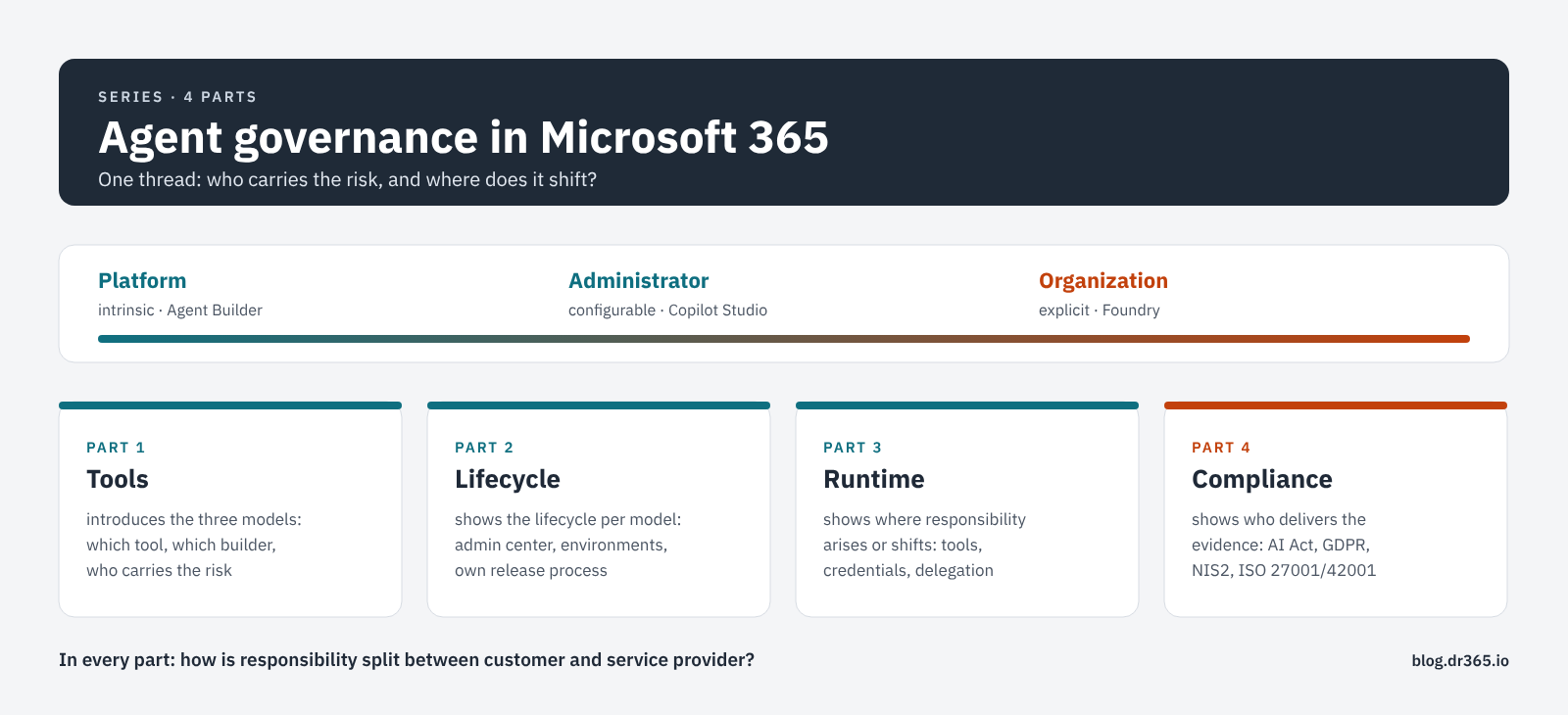
Part 1
Agent Builder, Copilot Studio or Foundry: who owns the risk?
Which tool fits which builder, and who carries the risk in each case: the platform, the administrator or the organization?
Part 2
Agent lifecycle: how much governance does a Copilot agent need?
How much lifecycle does an agent need, and how does it differ by platform?
Part 3
Runtime agent governance: whose permissions does a delegated agent use?
Whose permissions does an agent use at runtime, and where does responsibility shift?
Part 4
AI Act, GDPR, NIS2 and ISO: which controls for Microsoft 365 agents count more than once
Who has to provide which evidence, and how much of it comes from Microsoft 365?